
Height
The 1256 m Lovćen start gives the route a genuinely high opening perspective over the Bay.
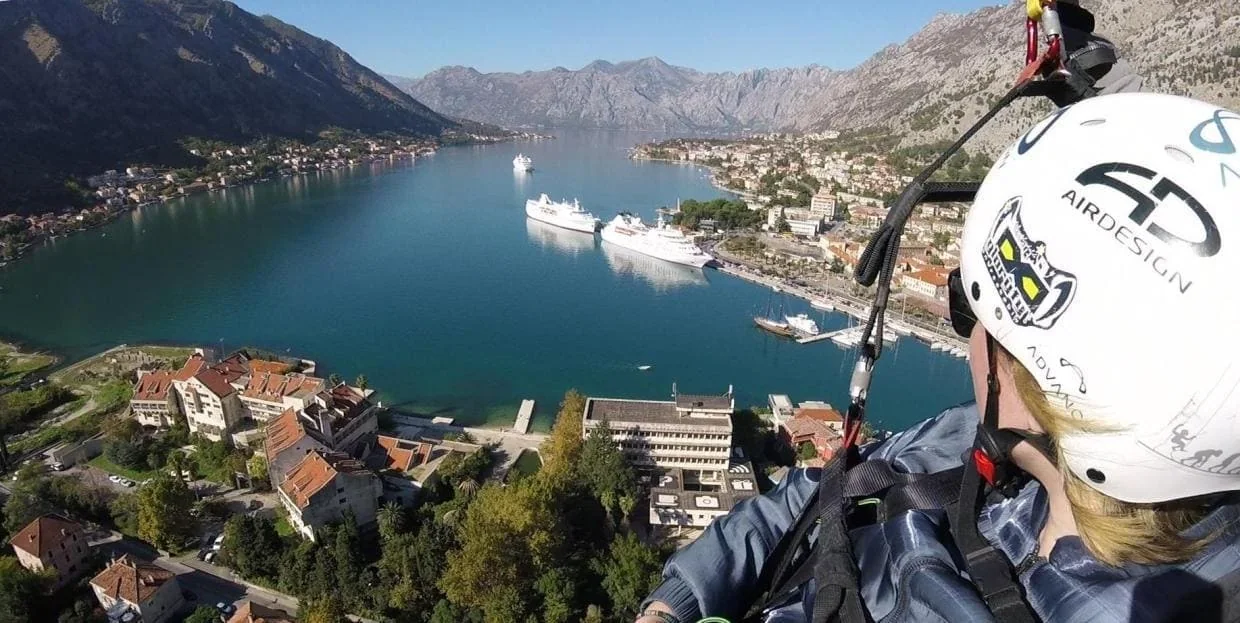
You leave the Lovćen slope with mountains and water spread far below. During the descent, St John Fortress, Kotor Old Town, the marina and the bay shore move from small landmarks into the centre of the view.
The 1256 m Lovćen start gives the route a genuinely high opening perspective over the Bay.
The Bay is fjord-like in appearance because steep mountain walls hold the water tightly, although Boka Kotorska is not a classic glacier-formed fjord.
St John Fortress and Kotor Old Town become progressively easier to read as the route descends.
What changes during the descent
The route begins with the whole Bay beneath you and ends with fortress walls, Old Town roofs, boats and waterfront becoming individual details.
The first view is broad: mountains, water and Kotor all sit far below the Lovćen launch.
The enclosed Bay keeps steep slopes and shoreline close together instead of opening onto a long sea horizon.
St John Fortress, red roofs, marina and waterfront become easier to read as the flight comes lower.
The route changes from a huge Bay panorama into a close aerial view of one historic town.
The Bay is enclosed by steep mountains, so the view feels gathered around one body of water rather than spread along a long shoreline. As you descend, St John Fortress and Kotor Old Town become increasingly prominent below you.
There is no useful universal 'best' view. Kotor is distinctive if you want an enclosed mountain-and-water landscape with a historic town and fortress directly under the route.
It is often described as fjord-like because of its steep mountain walls and enclosed water, but Boka Kotorska is not a classic glacier-formed fjord. Here, 'fjord-like' describes the appearance rather than the geological origin.
The first impression is scale: the Bay sits far below, with steep rock and mountains around it. Kotor is visible as part of the wider landscape rather than filling the view.
The wider geography gives way to details. St John Fortress, the Old Town roofs, roads, marina, boats and waterfront become much easier to distinguish.
No. Sun angle, haze, cloud, visibility, thermal lift and the exact flight line can all change what is most prominent on the day.
The photo gallery follows the route from just after takeoff through the high Bay views, St John Fortress, Old Town and the lower approach.
Use the contact page to send the local team your preferred day or date range and how many people want to fly.
The Lovćen launch sits at 1256 m above sea level. That height shapes the first part of the flight.
Just after takeoff, Kotor does not dominate the scene. The larger landscape does: steep mountain sides, the Bay far below, settlements following the shoreline and layers of rock stretching away from the water.
You begin by seeing how Kotor fits inside the Bay.
On an open coast, the eye can travel along a long horizon and a broad line between land and sea.
Kotor is different. Water is enclosed by steep slopes, bends and inner bays. The scene feels more contained, with mountain and water continuously framing each other.
The Bay is often described as fjord-like for that visual reason. Geologically, Boka Kotorska is not a classic glacier-formed fjord; the useful point here is simply what the shape looks like from the air.
The character of the view changes as the paraglider comes lower.
St John Fortress becomes more distinct on the rock above Kotor. The Old Town stops looking like a small patch of roofs and begins to show its street pattern and walls. Boats, the marina, waterfront and individual buildings become easy to separate.
The route moves from geography to place: first the whole Bay, then Kotor itself.
This is the part that is hard to reproduce on a broad coastal flight.
The fortress is on the mountain, the historic town sits immediately below it, and the Bay begins at the town walls. From the air, those elements remain visually connected instead of appearing as separate attractions visited one by one.
That compact relationship is what gives the Kotor route its identity.
The geography is stable; the atmosphere is not.
Bright sun can make the water and roofs sharply defined. Haze can soften the far side of the Bay. Cloud shadow can make the mountains feel heavier and closer. The flight line and height also change with the conditions.
So the route has a recognisable character without promising one identical postcard view.
Choose Kotor when the enclosed Bay, steep mountains, fortress and Old Town are part of why you want to fly.
A broad coastal flight can give more horizon, beach and open sea. Kotor gives a tighter relationship between mountain, water and a historic town.
Neither has to be “better.” They are different ways of seeing Montenegro from the air.
Basis: current Kotor route elevation, gallery images, visible landmarks and the 2026-10-07 local-pilot-team scenic rewrite.
Sun, haze, cloud, visibility, lift and the exact flight line change the view from day to day. Scenic wording should be rechecked if the route or image set changes materially.
If this is the view you want
The current tandem flight fee is €155 per participant. Send your preferred day or date range and passenger count; the final flying plan still depends on the current conditions.
Before you ask about a flight